
Fauvism

Fauvism was a short-lived but influential French movement (roughly 1904–1908) known for its extremely bold, non-naturalistic use of colour and simplified forms.

Historical & Social Context

Fauvism appeared during the Belle Époque, a period of relative peace and prosperity in France before the First World War, when Paris was a hub of experimentation in art, fashion, and entertainment. Building on Post-Impressionist colour theory, a group of young painters shocked the 1905 Salon d'Automne with canvases of such raw, clashing colour that a critic dubbed them "les fauves" ("the wild beasts").

Stylistic Characteristics

Intense, often unrealistic colour used purely for emotional and decorative effect; simplified, flattened forms; energetic, loose brushwork; rejection of traditional perspective and shading in favour of colour harmony.

Artists

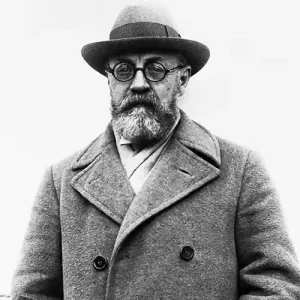
Henri Matisse

The movement's central figure, celebrated for his confident, decorative use of colour.

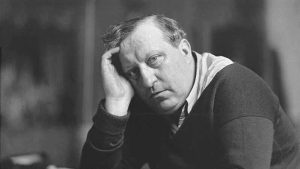
André Derain

Known for vivid landscapes and harbour scenes using unnatural colour combinations.

Artworks

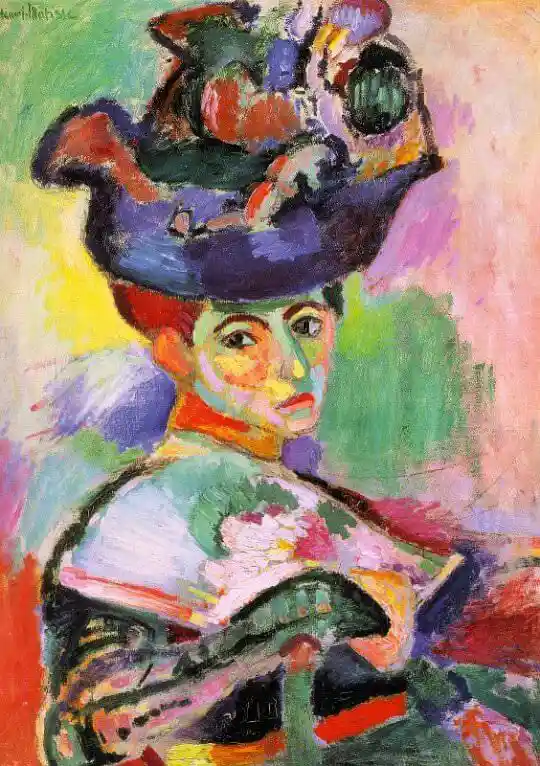
Woman with a Hat (1905) by Henri Matisse

A portrait rendered in patches of green, orange, and purple with no attempt at realistic skin tone.


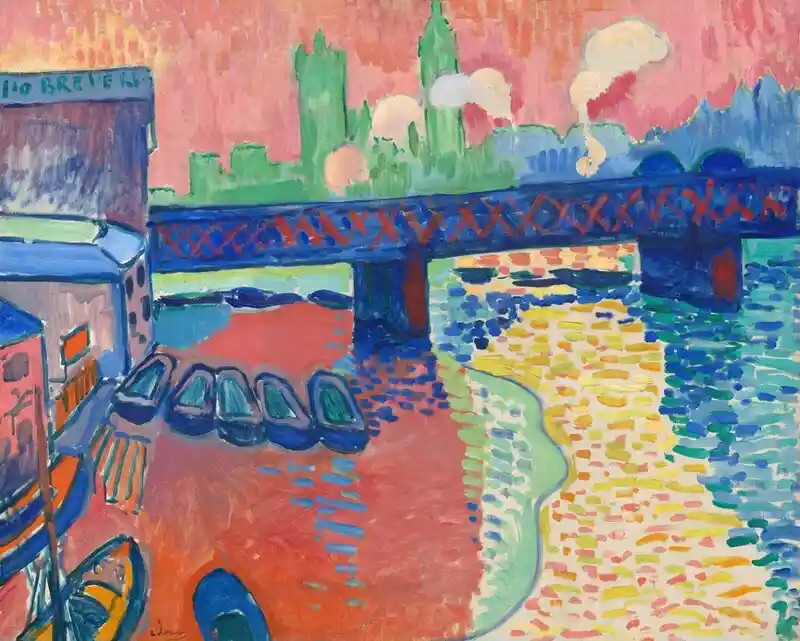
Charing Cross Bridge, London (1906) by André Derain

A bridge and river scene painted in bright, invented colours rather than the grey of an actual London day.
Influences

Stylistically, Fauvism drew directly on Post-Impressionist colour experiments and on African and Oceanic art, which several Fauvists collected and admired for its bold simplification. Economically and socially, a growing private art market and supportive dealers allowed such radical work to find buyers despite public shock. The relatively stable, prosperous pre-war atmosphere in France gave artists room to experiment playfully with colour rather than respond to crisis.

Insights

Fauvism matters because it showed that colour could be completely freed from the job of describing reality and used instead purely for feeling and design — an idea that influenced Expressionism and much of 20th-century abstraction.